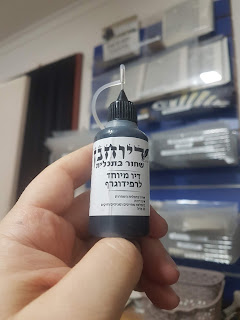
In today’s day and age, virtually every kosher product available to the consumer comes with a hechsher. By hechsher, I mean an official and recognised rabbinical body or agency that certifies the kashrus of a product, be it a food item or a religious article. Hechsherim play a vital role in providing consumer confidence, and something branded by a reputable kashrus agency will be considered more legitimate than a similar product that does not. The agency has rigid policies and protocols in place to ensure correct standards are met, and they are independent of the manufacturer so that there is no conflict of interest. As we have discussed on this forum previously, there is a distinct lack of official hechsherim on Sta”m products - Tefillin, Mezuzos and Sifrei Torah. Even the Vaad Mishmeres Sta”m, the oldest and most well- known rabbinic agency in the Sta”m world does not certify products. They test and ordain sofrim and magihim (examiners), offer a computer checking service (sp...
If the paper is very thick, you MAY be able to remove the dyo with a bowed razor blade held between your thumb and forefinger. Alternately, you could try scraping with a very sharp blade. I'd recommend the first method though, it's often possible to slice under the dyo without damaging the surface at all. Be sure to apply gum sandarac to the abraded area or the ink will most likely spread.
ReplyDeleteYou could also try an ink eraser gum. On paper, I doubt it's possible to make a perfect correction that will leave no trace.
This comment has been removed by the author.
ReplyDeleteBowed razor blades do work, but on many thick art papers they will leave a very clear mark at the place of the correction.
ReplyDeleteAnother suggestion is to use a #10 x-acto blade (the curved one). Hold the blade perpendicular to the page and VERY gently scrape in one direction, not back and forth. It may take a white, but with care this can remove the ink even from thin paper. When done, go over the area with a white rubber eraser and then, as Binyomin rightly points out, dust with gum sandarac and rewrite!
What is gum sandarac? Would that be used on klaf as well? I was taught on klaf to lightly rub a white pastel/chalk on erased area to keep ink from spreading.
ReplyDelete