A place for English speaking sofrim (scribes), magihim (examiners), rabbis and vendors of Stam (Torah, Tefillin and Mezuzah scrolls) from around the world to communicate, share ideas, ask questions and offer support and advice.
Rav Yosef Chaim Sonnenfeld, in T'shuvos Salmas Chaim, paskens that putting dashes between letters of a Shem Kodesh is meaningless: it's still a Shem Kodesh, dashes notwithstanding.
Interesting because most people are not noheg that way. Do you know of any teshuvos explicitly permitting writing a shem kodesh with dashes?
Regarding the post itself, I have old tefillin parshiyos where the second heh is made as a full Resh, whereas the Yalkut version has a compromise between a resh and the usual form of the daled. At what point did the minhag change?
There are different minhagim, i dont believe it changed. For instance, Zanz sofrim write the second hey with the usual protrusion to the right, like a regular hey. They also dont make the small oketz in the bottom left of the second hey unlike the diagram. In other words, there are slight differences among the different communities,
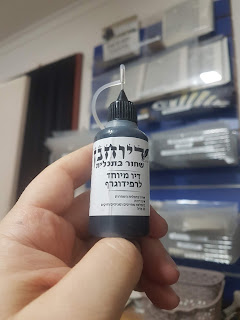
I recently tried this kosher ink for my rapidograph and I am extremely pleased with it. It does not clog the nib like other kosher rapidograph inks, and it's very dark and strong. It's at least as good as the Rotring commercial grade rapidograph inks (of course these can only be used with batch numbers that have been lab tested and approved kosher), and in addition you do not need to add a drop of regular Sta"m ink (as per the instruction of the Shevet Halevi, which is messy and time consuming). I was wondering if anyone else had an opinion or comments with regards to their experience with this ink...
We all know that there is no ancient source that requires ink to be מן המותר בפיך . Possibly, as said here before, because in the olden days ink was always מן המותר בפיך and the question was never raised. It was probably self-evident. Nowadays, no decent Rav will approve an ink which is not מן המותר בפיך . Who was the first one to raise this question? Was it raised because of animal ingredients or because of non-kosher wine?
In today’s day and age, virtually every kosher product available to the consumer comes with a hechsher. By hechsher, I mean an official and recognised rabbinical body or agency that certifies the kashrus of a product, be it a food item or a religious article. Hechsherim play a vital role in providing consumer confidence, and something branded by a reputable kashrus agency will be considered more legitimate than a similar product that does not. The agency has rigid policies and protocols in place to ensure correct standards are met, and they are independent of the manufacturer so that there is no conflict of interest. As we have discussed on this forum previously, there is a distinct lack of official hechsherim on Sta”m products - Tefillin, Mezuzos and Sifrei Torah. Even the Vaad Mishmeres Sta”m, the oldest and most well- known rabbinic agency in the Sta”m world does not certify products. They test and ordain sofrim and magihim (examiners), offer a computer checking service (sp...

Rav Yosef Chaim Sonnenfeld, in T'shuvos Salmas Chaim, paskens that putting dashes between letters of a Shem Kodesh is meaningless: it's still a Shem Kodesh, dashes notwithstanding.
ReplyDeleteInteresting because most people are not noheg that way. Do you know of any teshuvos explicitly permitting writing a shem kodesh with dashes?
ReplyDeleteRegarding the post itself, I have old tefillin parshiyos where the second heh is made as a full Resh, whereas the Yalkut version has a compromise between a resh and the usual form of the daled. At what point did the minhag change?
There are different minhagim, i dont believe it changed. For instance, Zanz sofrim write the second hey with the usual protrusion to the right, like a regular hey. They also dont make the small oketz in the bottom left of the second hey unlike the diagram. In other words, there are slight differences among the different communities,
Delete