A place for English speaking sofrim (scribes), magihim (examiners), rabbis and vendors of Stam (Torah, Tefillin and Mezuzah scrolls) from around the world to communicate, share ideas, ask questions and offer support and advice.
Assuming the negia created a mem for a moment (I'm not saying one way or the other at the moment) then it is pasul and Rav Friedlander was clear that this is the widely accepted psak. We had a similar discussion a few months ago regarding a chaf peshuta in which a dalet or reish below hit it in the midst of making the head.
Why would you not say that you can assume according to the normal way a Sofer writes the letter, the right Rosh would be written in a way that likely would create a mem before finishing the ayin.
Ie - I would think that's a likely case, not a 50/50 safek.
Eg a lamed that goes into a reish, we don't assume that the Sofer drew the tzavar from bottom to top, rather too to bottom. As oppose to a bet that goes into a reish we assume he writes the moshav from right to left...
A safek doesn't have to be a 50/50 chance. I can not accept the dugma of lamed, since I am not meikal like the Keset if the tzavar was written after the caf. My understanding of that hallacha is, that whenever the yud part of the lamed [completely] enters the dalet or reish, they are passul. And the same, if the akev of the beis enters these letters and they look like a hay, they are passul, regardless of lefties or righties.
there are opinions (rav shtern and others) which say that unless you clearly saw a mem - bematzah haksivah - that its ok (to scrape) and we needednt be choshesh what could have been
derech agav since this is an alter rebbe ksav then it is very common that the ayin is made from the bottom it also look like in this ksav that the sofer went from the bottom the question is did he make a head to attach before but ain nafkah minah i would really like to hear what reb moshe has to say
(1) R' Akiva Eiger is not Someich on the SM"K leKula, because, as he says in the Teshuva, most disagree. He is Choshesh leChumrah that the Sheim Hashem may still have Kedusha despite the apparent Chok Tochos. (2) Even if the sofer wrote the entire right-and-bottom of the Ayin in one stroke (lifting the Kolmus to then write the left part), it would still look like a Mem - unlike the case of a Lamed B'toch-Chof. If so, any mention of "just for a second" and "Lo Hitkaven" appear irrelevant.
Reb Moishe, according to your opinion is this mehudar? can we assume somebody spending 120$ to buy alter rebbe ksav wants to purchase a mezuza with this shaila?
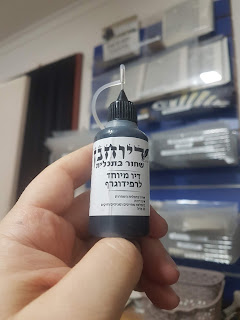
I recently tried this kosher ink for my rapidograph and I am extremely pleased with it. It does not clog the nib like other kosher rapidograph inks, and it's very dark and strong. It's at least as good as the Rotring commercial grade rapidograph inks (of course these can only be used with batch numbers that have been lab tested and approved kosher), and in addition you do not need to add a drop of regular Sta"m ink (as per the instruction of the Shevet Halevi, which is messy and time consuming). I was wondering if anyone else had an opinion or comments with regards to their experience with this ink...
We all know that there is no ancient source that requires ink to be מן המותר בפיך . Possibly, as said here before, because in the olden days ink was always מן המותר בפיך and the question was never raised. It was probably self-evident. Nowadays, no decent Rav will approve an ink which is not מן המותר בפיך . Who was the first one to raise this question? Was it raised because of animal ingredients or because of non-kosher wine?
In today’s day and age, virtually every kosher product available to the consumer comes with a hechsher. By hechsher, I mean an official and recognised rabbinical body or agency that certifies the kashrus of a product, be it a food item or a religious article. Hechsherim play a vital role in providing consumer confidence, and something branded by a reputable kashrus agency will be considered more legitimate than a similar product that does not. The agency has rigid policies and protocols in place to ensure correct standards are met, and they are independent of the manufacturer so that there is no conflict of interest. As we have discussed on this forum previously, there is a distinct lack of official hechsherim on Sta”m products - Tefillin, Mezuzos and Sifrei Torah. Even the Vaad Mishmeres Sta”m, the oldest and most well- known rabbinic agency in the Sta”m world does not certify products. They test and ordain sofrim and magihim (examiners), offer a computer checking service (sp...
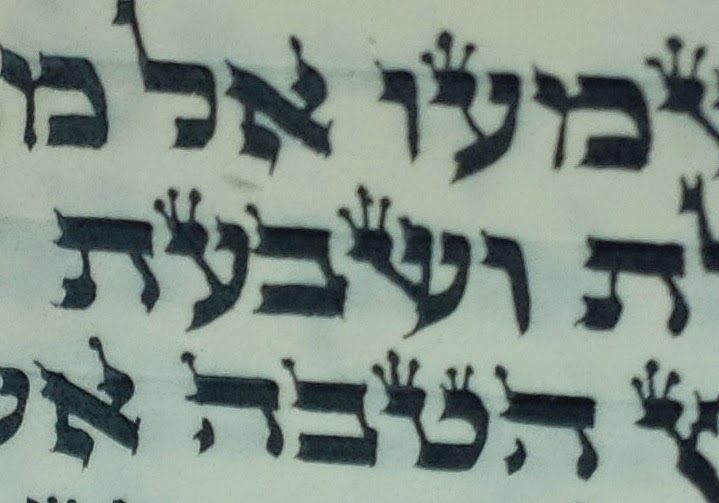
I am meikal to erase the negiya
ReplyDeleteAssuming the negia created a mem for a moment (I'm not saying one way or the other at the moment) then it is pasul and Rav Friedlander was clear that this is the widely accepted psak. We had a similar discussion a few months ago regarding a chaf peshuta in which a dalet or reish below hit it in the midst of making the head.
ReplyDeleteI am leaving that assumption (that it may have been a mem for a moment) as a safek!
ReplyDeleteRav Moshe
ReplyDeleteWhy would you not say that you can assume according to the normal way a Sofer writes the letter, the right Rosh would be written in a way that likely would create a mem before finishing the ayin.
Ie - I would think that's a likely case, not a 50/50 safek.
Eg a lamed that goes into a reish, we don't assume that the Sofer drew the tzavar from bottom to top, rather too to bottom. As oppose to a bet that goes into a reish we assume he writes the moshav from right to left...
A safek doesn't have to be a 50/50 chance.
DeleteI can not accept the dugma of lamed, since I am not meikal like the Keset if the tzavar was written after the caf. My understanding of that hallacha is, that whenever the yud part of the lamed [completely] enters the dalet or reish, they are passul. And the same, if the akev of the beis enters these letters and they look like a hay, they are passul, regardless of lefties or righties.
there are opinions (rav shtern and others) which say that unless you clearly saw a mem - bematzah haksivah - that its ok (to scrape) and we needednt be choshesh what could have been
ReplyDeleteRav Moshe: If the possibility of a Mem is a Safek, why is this not a S'feika D'Oraisa? What is the basis to be Meikal here? Please advise.
ReplyDeleteEli,
ReplyDeleteIs it OK if I make blog about this question in Hebrew. In english it will be too long [complicated]?
derech agav since this is an alter rebbe ksav then it is very common that the ayin is made from the bottom it also look like in this ksav that the sofer went from the bottom the question is did he make a head to attach before but ain nafkah minah i would really like to hear what reb moshe has to say
ReplyDeletehttp://hebrewstam.blogspot.co.il/2014/06/blog-post_10.html
ReplyDeleteI didn't put it on this forum, because it's in hebrew and long.
This comment has been removed by the author.
DeleteThank you for the Hebrew posting.
Delete(1) R' Akiva Eiger is not Someich on the SM"K leKula, because, as he says in the Teshuva, most disagree. He is Choshesh leChumrah that the Sheim Hashem may still have Kedusha despite the apparent Chok Tochos.
(2) Even if the sofer wrote the entire right-and-bottom of the Ayin in one stroke (lifting the Kolmus to then write the left part), it would still look like a Mem - unlike the case of a Lamed B'toch-Chof. If so, any mention of "just for a second" and "Lo Hitkaven" appear irrelevant.
The S'feika D'Oraisa still seems to loom...
Reb Moishe, according to your opinion is this mehudar? can we assume somebody spending 120$ to buy alter rebbe ksav wants to purchase a mezuza with this shaila?
ReplyDeleteThe question was not, if it is mehudar.
ReplyDeleteI understood the question as request for a kula. To be machmir nobody needed to ask me.