In today’s day and age, virtually every kosher product available to the consumer comes with a hechsher. By hechsher, I mean an official and recognised rabbinical body or agency that certifies the kashrus of a product, be it a food item or a religious article. Hechsherim play a vital role in providing consumer confidence, and something branded by a reputable kashrus agency will be considered more legitimate than a similar product that does not. The agency has rigid policies and protocols in place to ensure correct standards are met, and they are independent of the manufacturer so that there is no conflict of interest. As we have discussed on this forum previously, there is a distinct lack of official hechsherim on Sta”m products - Tefillin, Mezuzos and Sifrei Torah. Even the Vaad Mishmeres Sta”m, the oldest and most well- known rabbinic agency in the Sta”m world does not certify products. They test and ordain sofrim and magihim (examiners), offer a computer checking service (sp...
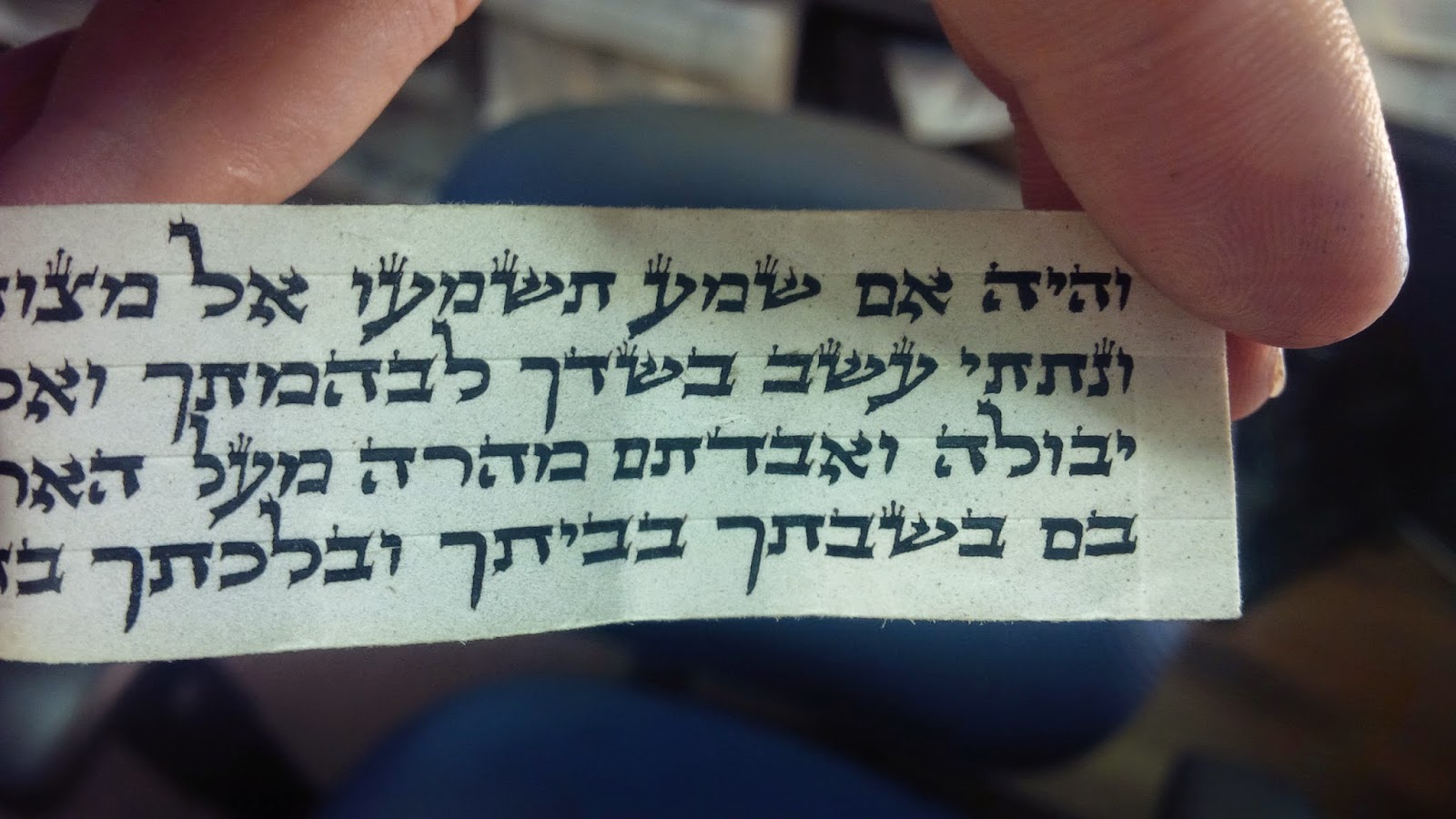
Is there revach at the end of shema before it?
ReplyDeleteSame as normal
ReplyDelete500 years ago most Ashkenazi tefillin were like this.
ReplyDeleteIsn't there a minority de'ah that is noheg to write ALL of the parshiyot as petuhot? I know I've seen in before (maybe in the MB) but I can't recall offhand...maybe there is a way to machshir, the ktav is beautiful, chaval to put it in the geniza :*-/
ReplyDeleteיעשה כל פרשיותיה פתוחות חוץ מפרשה אחרונה הכתובה בתורה שהיא והיה אם שמוע שיעשנה סתומה ואם שינה פסול.
ReplyDeleteויש מכשירים בכולם פתוחות (מהר"ם פאדו"ה סימן פ"ז בשם אורחות חיים ובית יוסף בשם העיטור).
ובמדינות אלו נוהגים אף פרשת והיה אם שמוע בראש השיטה כשאר הפרשיות.
MB does say that this is only b'dieved, however.
Dov Ber, thank u for citing ;-)
DeleteReb Eli what's the status of the parshiyot and what's to be done with them?
Who wrote them I think the ktav is very nice
The owner opted to change the last parsha after consultation with a posek
DeleteThis comment has been removed by the author.
ReplyDeleteWow!
DeleteThis is amazing. Not is the Ram"a completely comfortable with this, but whats more is that it is a Shel Rosh Parshah i.e. not attached to the preceding Parshah. As a result there is not such thing as a real "stumah" anyway!!! See Magen Avraham 32:49, Mishnah Berurah 32:36 S"K 155, Shu"A Harav 32:54.
Furthermore, it is on precisely something like this that the Poskim insist on its acceptability after that fact "shelo le'hotzi laaz al Ha'rishonim"!!!
I feel like this is a classic, yet unfortunate, case in which the fact that we are not as poor as they once were facilitates us being "machmir" on a whim. In truth, all there is are Halachik guidelines. According to the Halachah these are perfectly acceptable.
Eli, I would be very grateful if you could find out what was the Rational of the Posek for laying to rest this beautiful Parshah.
Perhaps I am misguided.
Thanks.
Well they would only be kosher B'Diavad. According to many opinions(Rav S.Z. Auerbach and Rav Ovadiah Yosef come immediately to mind) it is forbidden to make a Baracha over B'diavad tefillin or mezzuzot.
DeleteWhat would be the point of having Tefillin that you couldn't say a Bracha on?