In today’s day and age, virtually every kosher product available to the consumer comes with a hechsher. By hechsher, I mean an official and recognised rabbinical body or agency that certifies the kashrus of a product, be it a food item or a religious article. Hechsherim play a vital role in providing consumer confidence, and something branded by a reputable kashrus agency will be considered more legitimate than a similar product that does not. The agency has rigid policies and protocols in place to ensure correct standards are met, and they are independent of the manufacturer so that there is no conflict of interest. As we have discussed on this forum previously, there is a distinct lack of official hechsherim on Sta”m products - Tefillin, Mezuzos and Sifrei Torah. Even the Vaad Mishmeres Sta”m, the oldest and most well- known rabbinic agency in the Sta”m world does not certify products. They test and ordain sofrim and magihim (examiners), offer a computer checking service (sp...
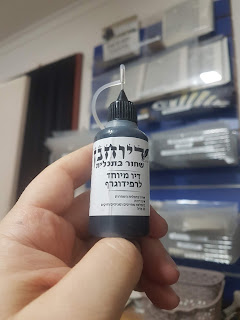
I am unsure as to the answer to your question however I used your ink (Dyo Lonetzach) to write a kesubah on shiny paper and with handling parts of the ink peeled off almost like it was a rubber coating on the paper.Is this because of the paper or is this normal for the ink? The paper was very shiny.
ReplyDelete1. Shiny paper has a coating on it to make it shiny. Some coatings behave like an oily coatings - nothing can stick to an oily coating, unless the ink soaks into the paper.
ReplyDelete2. Dio lanetzach dries in stages. After initial drying, the adhesion of the (dry) ink to the paper is still not cured. So, it can peel off. It takes a few days of drying to develop full-strength adhesion. Before making strength experiments on the ink I wait 3 weeks for complete drying and curing.
Ok, Thanks for explaining
ReplyDeletesee bnei yona that dio sjould be tzaf and omed
ReplyDelete