In today’s day and age, virtually every kosher product available to the consumer comes with a hechsher. By hechsher, I mean an official and recognised rabbinical body or agency that certifies the kashrus of a product, be it a food item or a religious article. Hechsherim play a vital role in providing consumer confidence, and something branded by a reputable kashrus agency will be considered more legitimate than a similar product that does not. The agency has rigid policies and protocols in place to ensure correct standards are met, and they are independent of the manufacturer so that there is no conflict of interest. As we have discussed on this forum previously, there is a distinct lack of official hechsherim on Sta”m products - Tefillin, Mezuzos and Sifrei Torah. Even the Vaad Mishmeres Sta”m, the oldest and most well- known rabbinic agency in the Sta”m world does not certify products. They test and ordain sofrim and magihim (examiners), offer a computer checking service (sp...
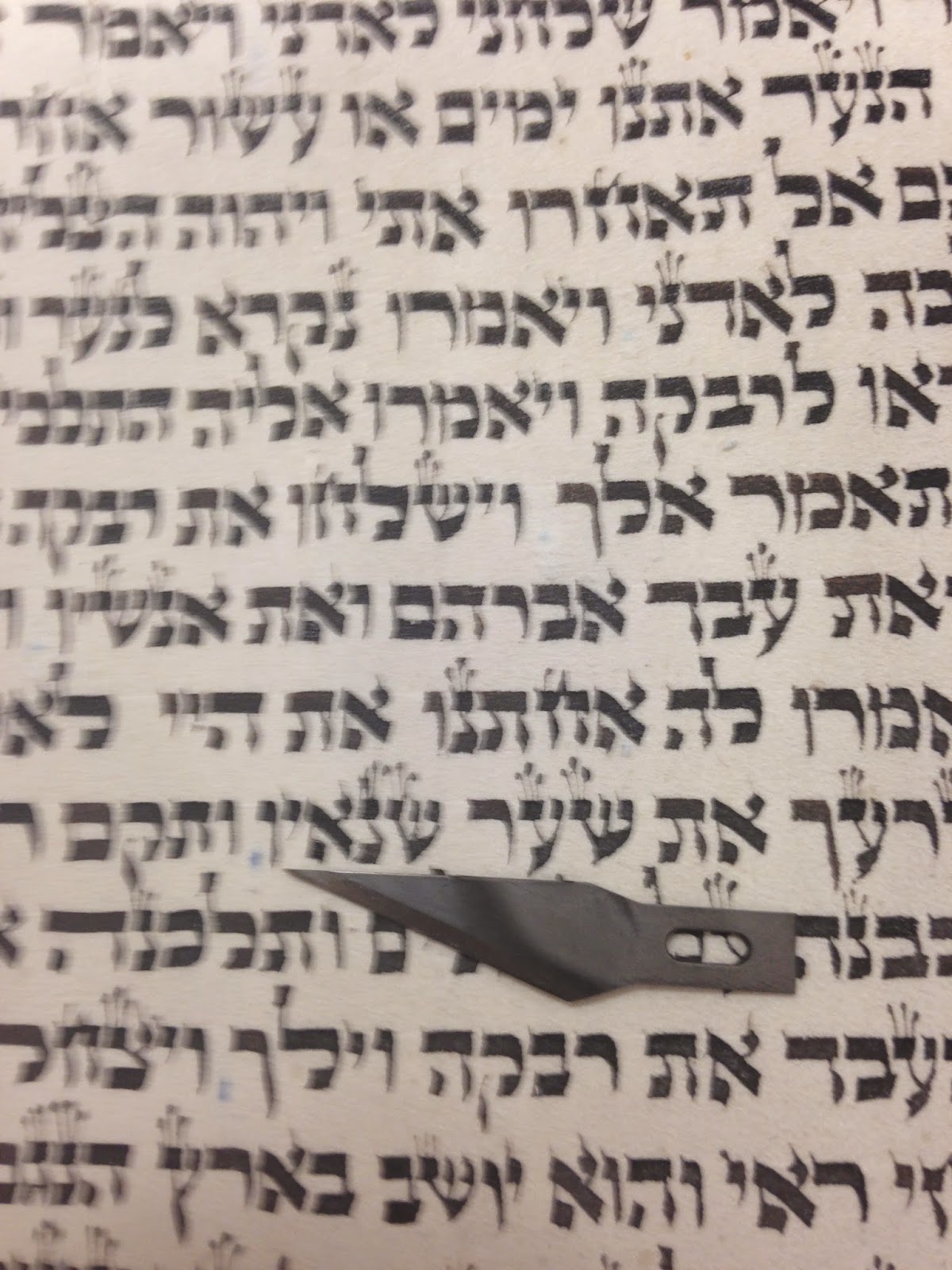
התמונה לא מספיק ברורה, אבל נראה בפשיטות שהוי"ו כשר. ומותר ורצוי לגרר הדיו הכחול
ReplyDeleteHi Eli,
ReplyDeleteNot only is there an ink mark there, but also after 1) ELECH, 2) ANASHAV, 3) SONeAV, 4)VAYELAKH. Obviously, someone marked all of the ends of PESSUKIM with blue ink, rendering this TORAH passul... for we admit of no extra marks on the scroll. There is no other choice, but to go and remove all of them.
Question, is the blue ink so engrained and absorbed into the KLAF, so that when you scrape, you are not able to remove it in its entirety?
For example, it appears from the picture that you have tried removing the mark after ELECH. However, there is still a small residue remaining. Ultimately, if the ink has been absorbed into the klaf, there is a point at which one can no longer proceed; for by scraping one risks making a hole onto the parchment.
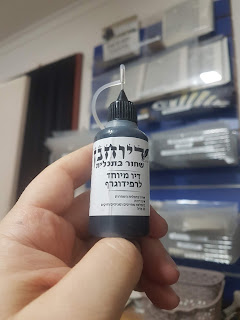
Does anyone know of a good chemical process for removing blue ink? I have just tried a little alcohol, as well as acetone on a q-tip. Both seem to work by helping dissolve + lifting-up the ink. Any other ideas out there?